Allied Nivelle Offensive ends in failure
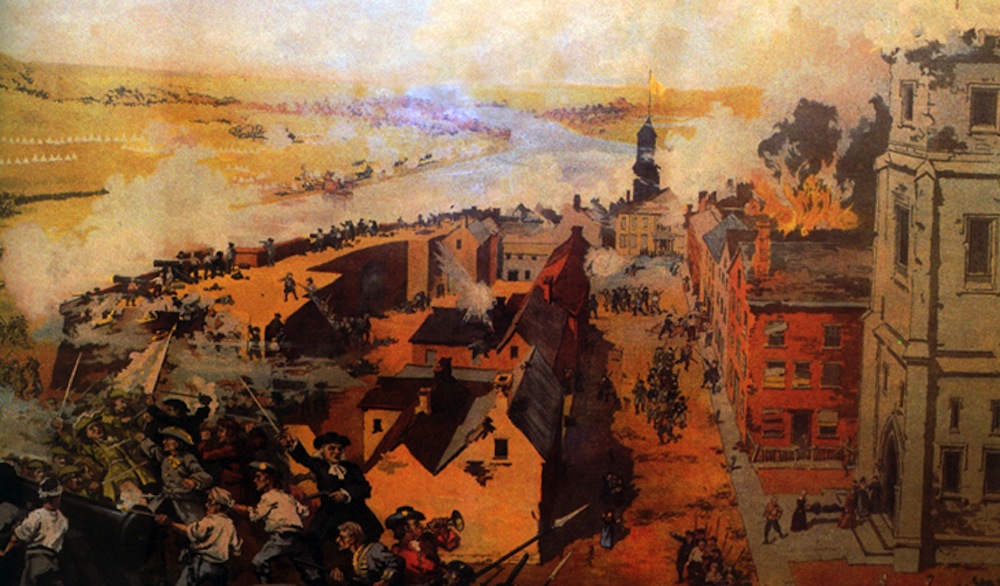
On this day in 1917 an ambitious Allied offensive against German troops near the Aisne River in central France spearheaded by the French commander in chief Robert Nivelle ends in dismal failure.Nivelle who had replaced Joseph Joffre in December 1915 as head of all French forces had tenaciously argued for a major spring offensive in spite of powerful opposition in the French government at one point threatening to resign if the offensive did not go ahead.He was convinced that by implementing the tactics he had used to considerable success at Verdun during the French counter-attacks in the fall of 1916 on a greater scale the Allies could achieve a breakthrough on the Western Front within 48 hours.In preparation for the planned offensive at the Aisne River the British army began its attacks on April 9 around the town of Arras capital of the Artois region of France with the limited objective of pulling German reserve troops away from the Aisne where the French would launch the central thrust of the offensive.Of the nearly 1000 heavy guns used in the attacks 377 were aimed at a six-kilometer stretch of front facing Vimy Ridge a high point overlooking the plains of Artois France to the east.
The Canadian Corps was given the task of moving forward to capture the ridge itself directed by photographic images taken by aerial reconnaissance crafts used to plan the attacks as well as to report progress during their execution.After overcoming 4000 yards of German defenses the Canadians captured Vimy Ridge on April 12a national triumph for Canada and a successful outcome for the initial phase of the Nivelle Offensive as the Germans were forced to double their strength in the Arras region and thus draw forces away from the area further south where Nivelle was preparing to launch his attacks.On April 16 Nivelle and the French began their assault along an 80-kilometer front stretching from Soissons to Reims along the Aisne River.Despite the evacuation of reserve troops to Arras the German positions were deeply and strongly entrenched in the region which they had occupied since September 1914.
The Germans had ample warning of French intentions from their intelligence systems this combined with the depth of their positions meant that the Allies were literally outgunned from the beginning of the battle.The overconfident Nivelle had ordered a rate of advance of up to two kilometers per hour which proved exceedingly difficult with the steep grade of the land horrible weather and the strength of enemy fire.For this attack known as the Second Battle of the Aisne the French used tanks in great numbers for the first time by the end of the first day however 57 of 132 tanks had been destroyed and 64 more had become bogged down in the mud.All in all the French suffered 40000 casualties on April 16 alone a loss comparable to that suffered by the British on the first day of the Battle of the Somme offensive of July 1 1916.
It was clear from the start that the attack had failed to achieve the decisive breakthrough Nivelle had planned over the next three days the French made only modest gains advancing up to seven kilometers on the west of the front and taking 20000 German prisoners.On the rest of the front progress was significantly slower and Nivelle was forced to call off the attacks on April 20.The high casualty rate among French forces during the ill-fated Nivelle Offensive combined with the continuing effects of exhausting battles at Verdun and the Somme led to sharply increased discontent among the soldiers on the Western Front.Mutinies began in late April 1917 and by June had affected 68 divisions or about 40000 troops.
The armys response to this was quick on April 25 Nivelle was dismissed as commander in chief.He was replaced by the more cautious Philippe Petain the hero of the Verdun resistance on May 8.Petain immediately responded to the soldiers complaints knowing that mutinies must be quelled in order to have a hope of success on the battlefield.
Where Nivelle had cut soldiers leave in March 1917 releasing only 5 percent of the army at a time Petain increased it establishing a standard of 13 percent or ten days leave for each soldier every four months.