First liquid-fueled rocket
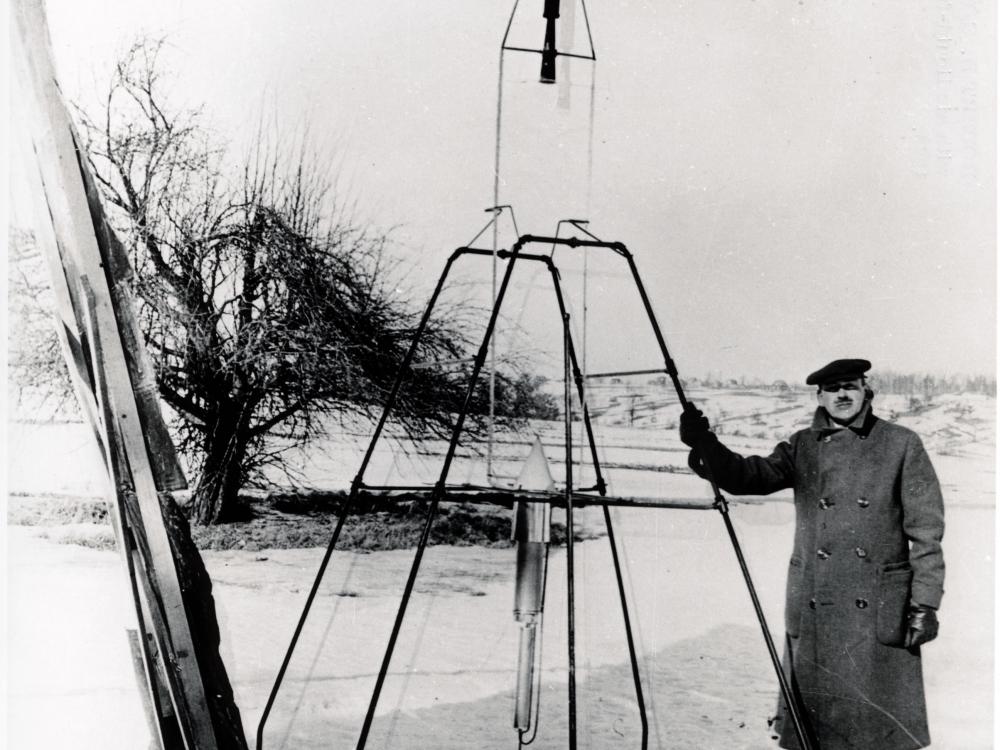
The first man to give hope to dreams of space travel is American Robert H.Goddard who successfully launches the worlds first liquid-fueled rocket at Auburn Massachusetts on March 16 1926.The rocket traveled for 2.5 seconds at a speed of about 60 mph reaching an altitude of 41 feet and landing 184 feet away.
The rocket was 10 feet tall constructed out of thin pipes and was fueled by liquid oxygen and gasoline.The Chinese developed the first military rockets in the early 13th century using gunpowder and probably built firework rockets at an earlier date.Gunpowder-propelled military rockets appeared in Europe sometime in the 13th century and in the 19th century British engineers made several important advances in early rocket science.In 1903 an obscure Russian inventor named Konstantin E.
Tsiolkovsky published a treatise on the theoretical problems of using rocket engines in space but it was not until Robert Goddards work in the 1920s that anyone began to build the modern liquid-fueled type of rocket that by the early 1960s would be launching humans into space.Goddard born in Worcester Massachusetts in 1882 became fascinated with the idea of space travel after reading the H.G.Wells science fiction novel War of the Worlds in 1898.He began building gunpowder rockets in 1907 while a student at the Worcester Polytechnic Institute and continued his rocket experiments as a physics doctoral student and then physics professor at Clark University.
He was the first to prove that rockets can propel in an airless vacuum-like space and was also the first to explore mathematically the energy and thrust potential of various fuels including liquid oxygen and liquid hydrogen.He received U.S.patents for his concepts of a multistage rocket and a liquid-fueled rocket and secured grants from the Smithsonian Institute to continue his research.In 1919 his classic treatise A Method of Reaching Extreme Altitudes was published by the Smithsonian.
The work outlined his mathematical theories of rocket propulsion and proposed the future launching of an unmanned rocket to the moon.The press picked up on Goddards moon-rocket proposal and for the most part ridiculed the scientists innovative ideas.In January 1920 The New York Times printed an editorial declaring that Dr.
Goddard seems to lack the knowledge ladled out daily in high schools because he thought that rocket thrust would be effective beyond the earths atmosphere.(Three days before the first Apollo lunar-landing mission in July 1969 the Times printed a correction to this editorial.)In December 1925 Goddard tested a liquid-fueled rocket in the physics building at Clark University.He wrote that the rocket which was secured in a static rack operated satisfactorily and lifted its own weight.
On March 16 1926 Goddard accomplished the worlds first launching of a liquid-fueled rocket from his Aunt Effies farm in Auburn.Goddard continued his innovative rocket work until his death in 1945.His work was recognized by the aviator Charles A.Lindbergh who helped secure him a grant from the Guggenheim Fund for the Promotion of Aeronautics.
Using these funds Goddard set up a testing ground in Roswell New Mexico which operated from 1930 until 1942.During his tenure there he made 31 successful flights including one of a rocket that reached 1.7 miles off the ground in 22.3 seconds.Meanwhile while Goddard conducted his limited tests without official U.S.
support Germany took the initiative in rocket development and by September 1944 was launching its V-2 guided missiles against Britain to devastating effect.During the war Goddard worked in developing a jet-thrust booster for a U.S.Navy seaplane.
He would not live to see the major advances in rocketry in the 1950s and 60s that would make his dreams of space travel a reality.NASAs Goddard Space Flight Center in Greenbelt Maryland is named in his honor.