Leaning Tower needs help
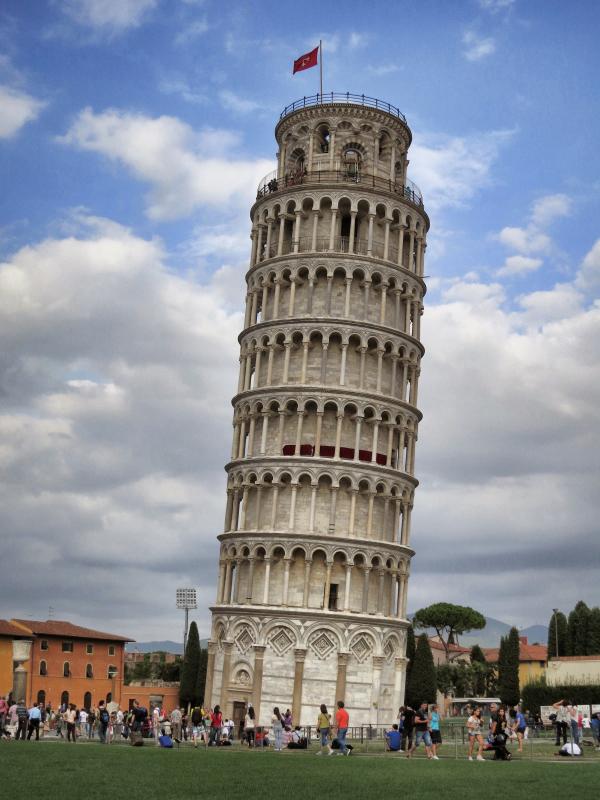
On February 27 1964 the Italian government announces that it is accepting suggestions on how to save the renowned Leaning Tower of Pisa from collapse.The top of the 180-foot tower was hanging 17 feet south of the base and studies showed that the tilt was increasing by a fraction every year.Experts warned that the medieval buildingone of Italys top tourist attractionswas in serious danger of toppling in an earthquake or storm.
Proposals to save the Leaning Tower arrived in Pisa from all over the world but it was not until 1999 that successful restorative work began.On August 9 1173 construction began on the Leaning Tower which was to house the bells of the vast cathedral of the Piazza dei Miracoli the Place of Miracles.Pisa at the time was a major trading power and one of the richest cities in the world and the bell tower was to be the most magnificent Europe had ever seen.However when the tower was just over three stories tall construction stopped for an unknown reason.
It may have been because of economic or political strife or the engineers may have noticed that even then the tower had begun to sink down into the ground on one side.In recent years it has been determined that the towers lean is caused by the remains of an ancient river estuary located under the building.The ground is made up in large part of water and silty sand and one side of the heavy marble building began gradually sinking into the ground as soon as the foundation was laid.The 95-year pause in construction allowed the building to settle somewhat and the new chief engineer sought to compensate for the towers visible lean by making the new stories slightly taller on the short side.In 1278 workers reached the top of the seventh story and construction was halted again.
By that time the southward tilt was nearly three feet.In 1360 work began on the bell chamber the eighth and final story and workers attempted to compensate for the lean by building the chamber at a slight slant with the rest of the tower.The tower was officially completed about 1370.Despite its growing lean the building was acclaimed as an architectural wonder and people came from far and wide to admire its 200 columns and six external arcades.The lean grew a little every year but this only increased interest in the tower.
A measuring from 1550 showed the top was 12 feet south of the base.In 1838 an architect was given permission to excavate the base of the tower a portion of which had sunk into the ground.As he dug water came sprouting out of the ground and the tower tilted another few inches south.In 1934 Benito Mussolini the dictator of Italy decided that the Leaning Tower was an inappropriate symbol for masculine Fascist Italy.
In an attempt to reverse the tilt engineers drilled holes into the foundation of the tower and some 200 tons of concrete was poured in.The tower abruptly lurched another few inches south.In the 1950s the heavy medieval bells in the tower were locked tight.In 1964 the Italian government publicly asked for suggestions on how to save the tower from what they believed was a forthcoming collapse.
Two years later a restorative attempt involving drilling was aborted when the tower tilted another fraction south.In 1985 another boring attempt likewise caused an increase in the lean.In 1990 the Italian government closed the Leaning Towers doors to the public out of safety concerns and began considering more drastic proposals to save the tower.In 1992 in an effort to temporarily stabilize the building plastic-coated steel tendons were built around the tower up to the second story.
The next year a concrete foundation was built around the tower in which counterweights were placed on the north side.The use of these weights lessened the tilt by nearly an inch.In 1995 the commission overseeing the restoration sought to replace the unsightly counterweights with underground cables.
Engineers froze the ground with liquid nitrogen in preparation but this actually caused a dramatic increase in the lean and the project was called off.Finally in 1999 engineers began a process of soil extraction under the north side that within a few months was showing positive effects.The soil was removed at a very slow pace no more than a gallon or two a day and a massive cable harness held the tower in the event of a sudden destabilization.Within six months the tilt had been reduced by over an inch and by the end of 2000 nearly a foot.
The tower was reopened to the public in December 2001 after a foot-and-a-half reduction had been achieved.It is thought that those 18 inches will give another 300 years of life to the Leaning Tower of Pisa.