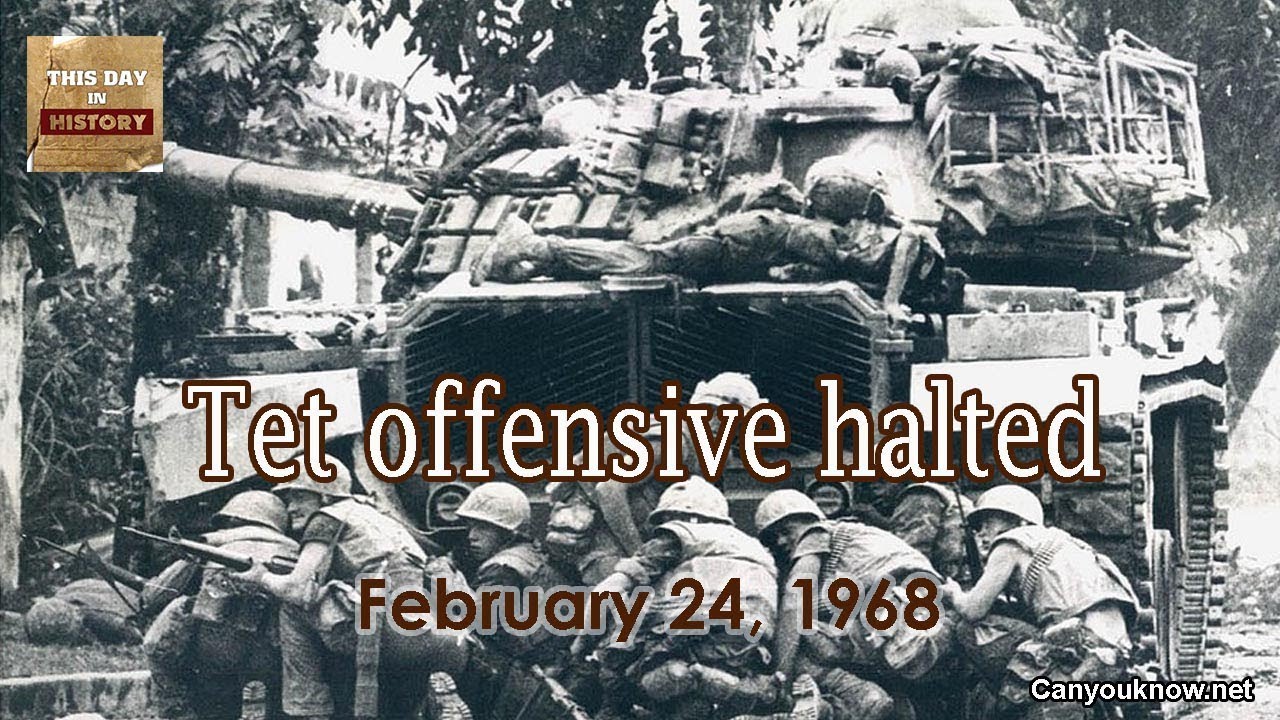
Tet offensive halted
On February 24 1968 the Tet Offensive ends as U.S.and South Vietnamese troops recapture the ancient capital of Hue from communist forces.Although scattered fighting continued across South Vietnam for another week the battle for Hue was the last major engagement of the offensive which saw communist attacks on all of South Vietnams major cities.
In the aftermath of Tet public opinion in the United States decisively turned against the Vietnam War.As 1968 beganthe third year of U.S.ground-troop fighting in VietnamU.S.military leadership was still confident that a favorable peace agreement would soon be forced on the North Vietnamese and their allies in South Vietnam the Viet Cong.
Despite growing calls at home for an immediate U.S.withdrawal President Lyndon Johnsons administration planned to keep the pressure on the communists through increased bombing and other attrition strategies.General William Westmoreland commander of U.S.
operations in Vietnam claimed to see clearly the light at the end of the tunnel and Johnson hoped that soon the shell-shocked communists would stumble out of the jungle to the bargaining table.However on January 30 1968 the Viet Cong and North Vietnamese launched their massive Tet Offensive all across South Vietnam.It was the first day of TetVietnams lunar new year and most important holidayand many South Vietnamese soldiers expecting an unofficial truce had gone home.The Viet Cong were known for guerrilla tactics and had never launched an offensive on this scale consequently U.S.
and South Vietnamese forces were caught completely by surprise.In the first day of the offensive tens of thousands of Viet Cong soldiers supported by North Vietnamese forces overran the five largest cities of South Vietnam scores of smaller cities and towns and a number of U.S.and South Vietnamese bases.The Viet Cong struck at SaigonSouth Vietnams capitaland even attacked and for several hours held the U.S.
embassy there.The action was caught by U.S.television news crews which also recorded the brutal impromptu street execution of a Viet Cong rebel by a South Vietnamese military official.As the U.S.
and South Vietnamese fought to regain control of Saigon the cities of Hue Dalat Kontum and Quangtri fell to the communists.U.S.and South Vietnamese forces recaptured most of these cities within a few days but Hue was fiercely contested by the communist soldiers occupying it.
After 26 days of costly house-to-house fighting the South Vietnamese flag was raised again above Hue on February 24 and the Tet Offensive came to an end.During the communist occupation of Hue numerous South Vietnamese government officials and civilians were massacred and many civilians died in U.S.bombing attacks that preceded the liberation of the city.In many respects the Tet Offensive was a military disaster for the communists They suffered 10 times more casualties than their enemy and failed to control any of the areas captured in the opening days of the offensive.
They had hoped that the offensive would ignite a popular uprising against South Vietnams government and the presence of U.S.troops.This did not occur.
In addition the Viet Cong which had come out into the open for the first time in the war were all but wiped out.However because the Tet Offensive crushed U.S.hopes for an imminent end to the conflict it dealt a fatal blow to the U.S.
military mission in Vietnam.In Tets aftermath President Johnson came under fire on all sides for his Vietnam policy.General Westmoreland requested 200000 more troops to overwhelm the communists and a national uproar ensued after this request was disclosed forcing Johnson to recall Westmoreland to Washington.On March 31 Johnson announced that the United States would begin de-escalation in Vietnam halt the bombing of North Vietnam and seek a peace agreement to end the conflict.
In the same speech he also announced that he would not seek reelection to the presidency citing what he perceived to be his responsibility in creating the national division over Vietnam.