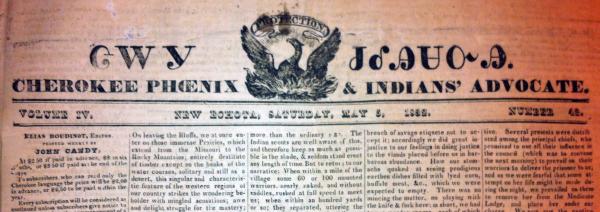
Cherokee receive their first printing press
The first printing press designed to use the newly invented Cherokee alphabet arrives at New Echota Georgia.The General Council of the Cherokee Nation had purchased the press with the goal of producing a Cherokee-language newspaper.The press itself however would have been useless had it not been for the extraordinary work of a young Cherokee named Sequoyah who invented a Cherokee alphabet.As a young man Sequoyah had joined the Cherokee volunteers who fought under Andrew Jackson against the British in the War of 1812.In dealing with the Anglo soldiers and settlers he became intrigued by their talking leaves-printed books that he realized somehow recorded human speech.
In a brilliant leap of logic Sequoyah comprehended the basic nature of symbolic representation of sounds and in 1809 began working on a similar system for the Cherokee language.Ridiculed and misunderstood by most of the Cherokee Sequoyah made slow progress until he came up with the idea of representing each syllable in the language with a separate written character.By 1821 he had perfected his syllabary of 86 characters a system that could be mastered in less than week.After obtaining the official endorsement of the Cherokee leadership Sequoyahs invention was soon adopted throughout the Cherokee nation.
When the Cherokee-language printing press arrived on this day in 1828 the lead type was based on Sequoyahs syllabary.Within months the first Indian language newspaper in history appeared in New Echota Georgia.It was called the Cherokee Phoenix.One of the so-called five civilized tribes native to the American Southeast the Cherokee had long embraced the United States program of civilizing Indians in the years after the Revolutionary War.
In the minds of Americans Sequoyahs syllabary further demonstrated the Cherokee desire to modernize and fit into the dominant Anglo world.The Cherokee used their new press to print a bilingual version of republican constitution and they took many other steps to assimilate Anglo culture and practice while still preserving some aspects of their traditional language and beliefs.Sadly despite the Cherokees sincere efforts to cooperate and assimilate with the Anglo-Americans their accomplishments did not protect them from the demands of land-hungry Americans.Repeatedly pushed westward in order to make room for Anglo settlers the Cherokee lost more than 4000 of their people (nearly a quarter of the nation) in the 1838-39 winter migration to Oklahoma that later became known as the Trail of Tears.
Nonetheless the Cherokee people survived as a nation in their new home thanks in part to the presence of the unifying written language created by Sequoyah.In recognition of his service the Cherokee Nation voted Sequoyah an annual allowance in 1841.He died two years later on his farm in Oklahoma.Today his memory is also preserved in the scientific name for the giant California redwood tree Sequoia.