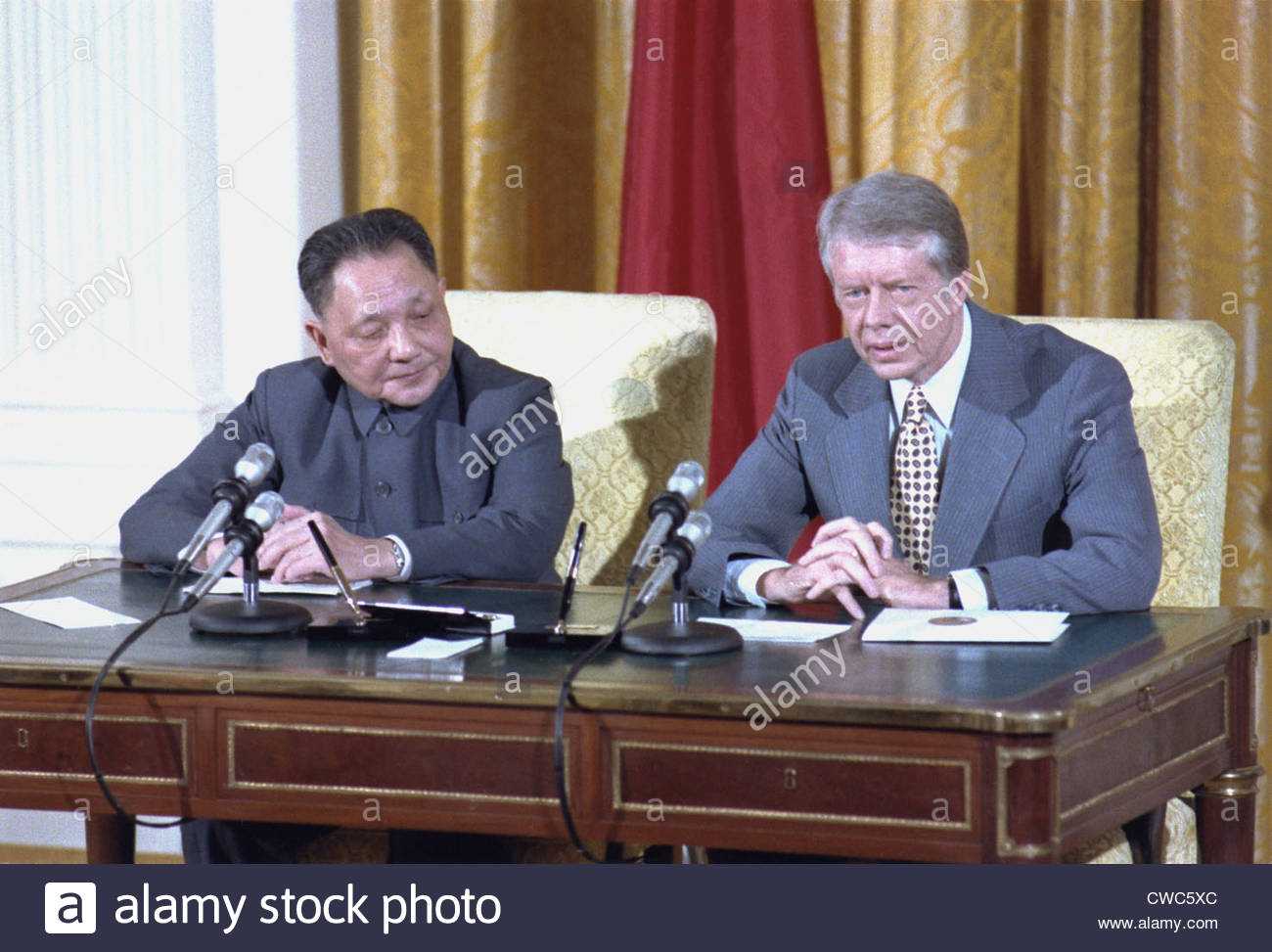
Deng Xiaoping and Jimmy Carter sign accords
On January 29 1979 Deng Xiaoping deputy premier of China meets President Jimmy Carter and together they sign historic new accords that reverse decades of U.S.opposition to the Peoples Republic of China.Deng Xiaoping lived out a full and complete transformation of China.The son of a landowner he joined the Chinese Communist Party (CCP) in 1920 and participated in Mao Zedongs Long March in 1934.
In 1945 he was appointed to the Party Central Committee and with the 1949 victory of the communists in the Chinese Civil War became the regional party leader of southwestern China.Called to Beijing as deputy premier in 1952 he rose rapidly became general secretary of the CCP in 1954 and a member of the ruling Political Bureau in 1955.A major policy maker he advocated individualism and material incentives in Chinas attempt to modernize its economy which often brought him into conflict with Mao and his orthodox communist beliefs.With the launch of the Cultural Revolution in 1966 Deng was attacked as a capitalist and removed from high party and government posts.
He disappeared from public view and worked in a tractor factory but in 1973 was reinstated by Premier Zhou Enlai who again made him deputy premier.When Zhou fell ill in 1975 Deng became the effective leader of China.In January 1976 Zhou died and in the subsequent power struggle Deng was purged by the Gang of Fourstrict Maoists who had come to power in the Cultural Revolution.In September however Mao Zedong died and Deng was rehabilitated after the Gang of Four fell from power.
He resumed his post as deputy premier often overshadowing Premier Hua Guofeng.Deng sought to open China to foreign investment and create closer ties with the West.In January 1979 he signed accords with President Jimmy Carter and later that year the United States granted full diplomatic recognition to the Peoples Republic of China.In 1981 Deng strengthened his position by replacing Hua Guofeng with his protege Hu Yaobang and together the men instituted widespread economic reforms in China.The reforms were based on capitalist models such as the decentralization of various industries material incentives as the reward for economic success and the creation of a skilled and well-educated financial elite.
As chief adviser to a series of successors he continued to be the main policy maker in China during the 1980s.Under Deng Chinas economy rapidly grew and citizens enjoyed expanded personal economic and cultural freedoms.Political freedoms were still greatly restricted however and China continued as an authoritative one-party state.In 1989 Deng hesitantly supported the government crackdown on the democratic demonstrations in Tiananmen Square.
Later that year he resigned his last party post but continued to be an influential adviser to the Chinese government until his death in 1997.