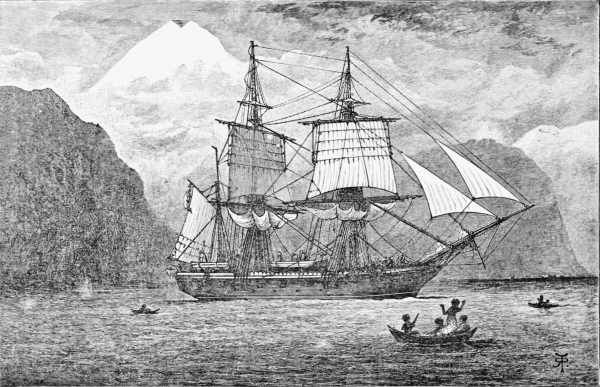
HMS Beagle departs England
British naturalist Charles Darwin sets out from Plymouth England aboard the HMS Beagle on a five-year surveying expedition of the southern Atlantic and Pacific oceans.Visiting such diverse places as the Galapagos Islands and New Zealand Darwin acquired an intimate knowledge of the flora fauna and geology of many lands.This information proved invaluable in the development of his theory of evolution first put forth in his groundbreaking scientific work of 1859 On the Origin of Species by Means of Natural Selection.Darwins theory argued that organisms gradually evolve through a process he called natural selection.
In natural selection organisms with genetic variations that suit their environment tend to propagate more descendants than organisms of the same species that lack the variation thus influencing the overall genetic makeup of the species.Most scientists quickly embraced the theory that solved so many puzzles of biological science but orthodox Christians condemned the work as heresy.Controversy over Darwins ideas deepened with the publication of The Descent of Man and Selection in Relation to Sex (1871) in which he presented evidence of mans evolution from apes.By the time of Darwins death in 1882 his theory of evolution had become generally accepted.
In honor of his scientific work he was buried in Westminster Abbey beside kings queens and other illustrious figures from British history.Subsequent developments in genetics and molecular biology led to modifications in accepted evolutionary theory but Darwins ideas remain central to the field.